
What this guide covers
The equity side of the Waters Corporation compensation package, based on Waters plan documents, filed employee award forms, and the company’s 2026 proxy materials:
- Which Waters equity plan governs your award
- How Waters RSUs are taxed at vest and why withholding may fall short
- How Waters PSU terms differ by grant year, including the 2026 changes
- How Qualifying Retirement works for PSUs under the 2020 plan
- How Waters stock appreciation rights work and why an exercise may require cash
- What the one-year protection means for converted BD awards
- Interactive Waters equity calculator for taxes, SAR value, and total stock exposure
For the broader financial planning issues that can sit around these awards, see our guidance for Waters Corporation employees.
Which Waters equity plan governs your award?
Many recent Waters-granted awards discussed in this guide are governed by the Waters Corporation 2020 Equity Incentive Plan. Longer-tenured employees may also hold awards issued under earlier plans. Awards converted from BD in connection with the February 9, 2026 combination are governed by the Waters Corporation 2026 Equity-Based Compensation Plan.
The 2026 plan was created specifically for substitute awards connected with the transaction. It covers stock appreciation rights and restricted stock units issued in place of certain BD stock appreciation rights, time-vested restricted stock units, and performance-based restricted stock units. The agreement attached to your specific award is the place to start because the rules differ by award type and grant history.
| Waters-granted award | Converted BD award | |
|---|---|---|
| Governing plan | Waters Corporation 2020 Equity Incentive Plan for the 2025 employee forms discussed here; older Waters awards may be governed by earlier plans | Waters Corporation 2026 Equity-Based Compensation Plan |
| Award types discussed here | Restricted stock units, performance stock units, and stock options | Restricted stock units and stock appreciation rights |
| Dates on the agreement | Date of Grant | Date of Grant and Original Grant Date |
| Retirement treatment | Depends on the award agreement; the employee PSU form filed in 2025 has a specific Qualifying Retirement definition | Exhibit B to the 2026 plan contains separate rules for converted RSUs and SARs |
| One-year protection after grant | No equivalent provision appears in the current employee forms reviewed for this article | A company termination within one year after the Grant Date, other than for Cause, can trigger full vesting of outstanding unvested RSUs or SARs |
How to tell which plan you haveOpen the agreement for the award in your stock plan account. The filed converted-award forms show both a Date of Grant and an Original Grant Date. The converted agreements also say that vesting continues under the terms that applied immediately before the transaction. A Waters-granted award uses the agreement and plan identified on that specific grant.
Waters RSUs: where the tax lands at vest
A restricted stock unit is a conditional right to receive a share when the unit vests. For a U.S. employee, the value delivered at vest generally becomes compensation income and is subject to income and payroll tax withholding.
The filed Waters RSU agreements reviewed for this guide allow the company to satisfy required withholding by holding back shares that otherwise would be issued, using a sell-to-cover arrangement, or using another permitted withholding method. That means the number of shares deposited into your account can be smaller than the number of units that vested.
Withholding and actual tax liability are not the same thing. IRS rules permit a 22% flat federal withholding rate for certain separately identified supplemental wages up to the applicable $1 million threshold. Your actual federal tax rate on that income depends on the rest of your tax return. If your marginal rate is higher than the withholding rate used, a vest can leave a tax shortfall even though taxes were withheld.
What the calculator assumesThe calculator below uses a 22% federal supplemental withholding assumption so you can compare estimated withholding with the marginal federal rate you enter. It does not predict the rate Waters will use on a particular vest or your final tax liability.
Waters PSUs: why your grant year matters
The employee non-CEO performance stock unit form Waters filed in May 2025 under the Waters Corporation 2020 Equity Incentive Plan starts with a target number of PSUs. The number ultimately earned depends on results over the performance period rather than on the target grant alone.
For that 2025 filed employee form, half of the target award is based on Waters’ relative total shareholder return against companies in the S&P 500 Health Care Index. The other half is based on constant-currency revenue growth. The table below reflects the 2025 filed form, not a universal formula for every Waters PSU grant.
| 2025 filed PSU metric | Result | Percentage earned |
|---|---|---|
| Relative TSR | At or above 75th percentile | 200% |
| Relative TSR | 50th percentile | 100% |
| Relative TSR | 25th percentile | 50% |
| Relative TSR | Below 25th percentile | 0% |
| Revenue growth | 8.80% or more | 200% |
| Revenue growth | 5.50% | 100% |
| Revenue growth | 2.75% | 50% |
| Revenue growth | Below 2.75% | 0% |
Results between the listed points are interpolated. Under that 2025 filed form, the relative-TSR portion is also capped at 100% of target if Waters’ own total shareholder return over the performance period is negative.
The range is not merely theoretical. Waters reported in its 2026 proxy that the 2023 PSU awards, whose performance period ended December 31, 2025, paid out at 65% of target.
What changed for 2026 PSUsWaters’ 2026 proxy says that, for the PSU program described for its named executive officers, the Compensation Committee replaced the prior OCCRG revenue-growth metric with an earnings-per-share, or EPS, metric beginning with 2026 PSUs. The proxy also says the prior post-vesting PSU holding requirement was eliminated beginning with the 2026 program.
That is different from the employee non-CEO PSU form filed in May 2025, which contains a twelve-month post-vesting transfer restriction. The 2026 proxy describes a one-year holding period for named executive officers generally under the prior program and a two-year period for the CEO.
The practical point is simple: do not assume a 2025 PSU table or holding restriction applies to a 2026 grant. Read the agreement attached to your own award. Grant year, role, and award form can change the terms.
Qualifying Retirement under the Waters 2020 PSU agreement
The employee non-CEO PSU agreement Waters filed in May 2025 under the 2020 plan uses a specific definition of Qualifying Retirement. All three conditions have to be met under that filed form:
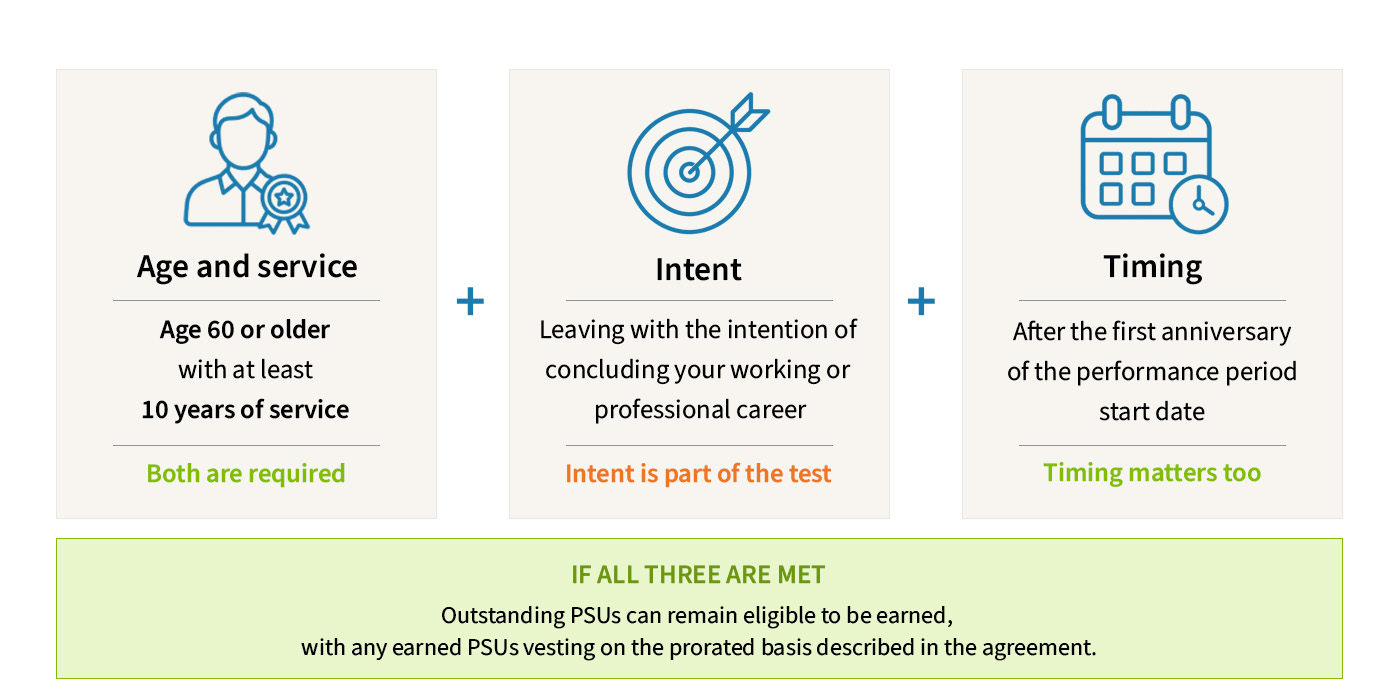
Based on the employee non-CEO Global Performance-Based Restricted Stock Unit Award Agreement filed in May 2025. Do not assume the same definition applies to every Waters award; your own agreement controls.
The intent condition matters because age and years of service alone do not satisfy the definition. Under the filed language, leaving at age 60 or older with at least ten years of service does not meet the Qualifying Retirement definition unless the other conditions are also met.
Death or total and permanent disability before the end of the performance period is treated differently. Under that May 2025 filed employee form, the target number of PSUs becomes vested and earned at termination, subject to the agreement’s terms.
Waters stock appreciation rights: how SARs work and why exercise may require cash
Stock appreciation rights appear in the 2026 plan because certain BD SARs were converted into Waters SARs in the transaction. A SAR is a right to the appreciation above an exercise price. If the stock price is at or below that exercise price, the SAR has no intrinsic value.
Two SAR details to verify before exercisingUse the Final Exercise Date shown in your award materials. The filed employee SAR agreement says the Final Exercise Date is the tenth anniversary of the Date of Grant, while Exhibit B to the 2026 plan describes the SAR term as ten years from the Original Grant Date. Because those two filed Waters documents use different date references, this guide does not resolve the difference by assumption. Use the actual expiration or Final Exercise Date shown in your award agreement or stock plan account.
Check the withholding requirement before choosing an exercise date. The filed converted employee SAR agreement says no shares will be issued until required federal, state, and local withholding has been remitted in cash or another arrangement acceptable to the company has been made.
On a large spread, the cash requirement can be significant. The calculator below estimates the spread and the withholding amount using the assumptions you enter.
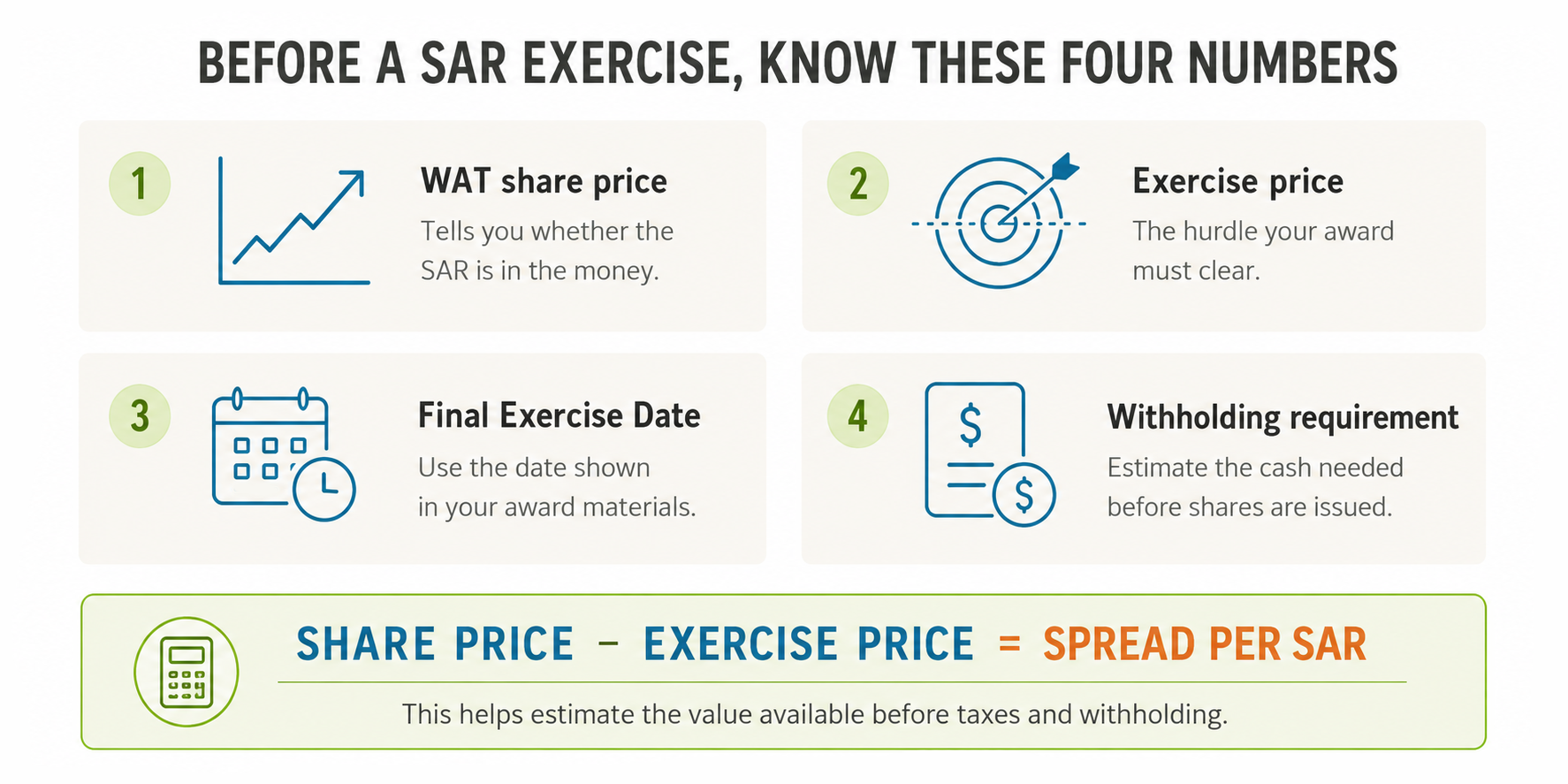
Confirm the terms in your own award materials before exercising. The Final Exercise Date and withholding requirements for your specific award control.
Converted BD awards: the one-year protection after the 2026 combination
The employee forms for converted RSUs and SARs contain the same important one-year provision. If Waters or one of its subsidiaries terminates the participant’s employment within one year following the Grant Date for a reason other than Cause, outstanding unvested RSUs or SARs vest in full immediately before the termination.
The protection is tied to the Grant Date shown on your converted Waters agreement. Do not assume the relevant date without checking the document in your account.
A resignation does not trigger this particular one-year acceleration clause. If you are considering a job change while a converted award is still inside its first year, compare the value of the unvested award with the consequences of leaving voluntarily before setting a departure date.
What happens to Waters equity when employment ends?
The answer depends on the plan and the award. Several rules that look similar at first produce very different outcomes:
| Award | Filed treatment summarized for forms reviewed |
|---|---|
| 2025 filed 2020-plan RSU form | Unvested RSUs are generally forfeited when employment ends, except for provisions such as death or total and permanent disability and any separate agreement that applies. |
| 2025 filed 2020-plan PSU form | Qualifying Retirement can keep outstanding PSUs eligible to be earned on the prorated basis described in the agreement. Death or total and permanent disability has separate treatment. |
| Converted 2026 time-based RSU | Exhibit B provides full vesting upon Retirement, death, or Disability. Unvested units are otherwise forfeited on voluntary or involuntary termination, subject to the separate one-year company-termination protection described above. |
| Converted 2026 performance-based RSU | Exhibit B provides prorated vesting in specified cases including termination without Cause, Retirement, Disability, death, or a 409A Disability, with settlement timing depending on the event. Other unvested units are forfeited, subject to the one-year protection where it applies. |
| Converted 2026 SAR | Upon death, Disability, or Retirement, unvested SARs become fully exercisable for the remaining term. After a voluntary termination or involuntary termination without Cause, vested SARs generally have a three-month exercise window. An involuntary termination with Cause forfeits unexercised SARs. The one-year protection can change the vesting result if its conditions are met. |
These are plan-level and form-agreement rules, not a substitute for your own documents. A severance agreement, employment agreement, country-specific appendix, company policy, or different award form can change the result. Before agreeing to a separation date, read the documents attached to each outstanding award.
How much Waters stock do you actually have?
Waters exposure can accumulate through more than one channel: vested shares in a brokerage account, shares acquired through an employee stock purchase plan, a Waters stock fund inside a workplace retirement account if available to you, RSUs and PSUs approaching vesting, and the intrinsic value of vested SARs. Converted awards can add another layer because their original grant history still matters.
Looking at each holding separately can hide the size of the total position. A useful concentration review brings the pieces together, then compares the result with the rest of your investable assets, your tax cost if shares are sold, any trading restrictions, and the amount of future compensation that also depends on Waters stock.
There is no single concentration percentage that fits every employee. The useful question is whether the size of the position is intentional and whether you understand what a material move in one stock would do to the rest of your plan.
The calculator below assembles the pieces.
Waters equity snapshot
Example values are prefilled. Replace them with your own figures. Everything updates as you type, and nothing is sent anywhere.
Units vesting
If you exercised your SARs today
Total Waters stock exposure
Stock Fund
Vesting units
SARs
Everything else
About this tool. An interactive educational tool. It performs arithmetic on the figures you enter and does not retrieve your account, plan, or award information. All calculations run in your browser. The figures you type are not transmitted to, collected by, or stored by Finivi Inc.
Assumptions and limitations. Results are estimates and are hypothetical in nature. For the RSU withholding comparison, the tool uses the IRS-permitted 22% flat supplemental-wage method as an assumption; an employer may use a different permitted method, and special rules apply above $1 million of annual supplemental wages. The tool also applies one flat federal marginal rate and one flat state rate. It does not account for the Social Security wage base, the additional Medicare tax, the Massachusetts surtax, the net investment income tax, filing status, deductions, other income, gains or losses on shares already held, taxes in states other than Massachusetts, or any trading window, blackout period, or preclearance obligation. SAR figures assume net settlement in shares at the price entered. The cash-withholding estimate uses a 22% federal supplemental-wage assumption, the state rate entered above, and 1.45% Medicare. Actual required withholding and accepted payment methods may differ; confirm your award materials and plan procedures before exercising. No result is a projection or forecast of future investment performance, of the price of any security, or of any tax outcome, and actual results will differ. A description of the criteria and methodology used, including all assumptions and limitations, is available on request at info@finivi.com.
Not advice. Educational only, and not personalized investment, tax, accounting, or legal advice. It is not a recommendation to buy, sell, or hold any security, to participate in or withdraw from any plan, or to exercise, hold, or sell any award. Finivi Inc. is not a law firm or an accounting firm. Confirm every provision against your award agreements and plan documents, which govern.
Seven Waters equity items to check this quarter
- Which plan governs each award. Check whether the document is a Waters-granted award under the 2020 plan or a converted award under the 2026 plan.
- The Grant Date and Original Grant Date on converted awards. The one-year protection is measured from the Grant Date shown on the converted Waters agreement.
- The grant year and terms on any PSU award. The May 2025 filed employee form uses the prior rTSR/revenue-growth structure and a twelve-month post-vesting restriction, while Waters says its 2026 NEO PSU program replaced the revenue metric with EPS and eliminated the holding requirement. Your own agreement controls.
- The retirement definition in your specific PSU agreement. The May 2025 filed employee PSU form uses age 60, ten years of service, career-ending intent, and a timing condition. Do not assume that definition governs every Waters award.
- The exercise price and stated Final Exercise Date on each SAR. Use the date shown in your award materials rather than recalculating it from the Grant Date or Original Grant Date, and estimate the cash required for withholding before choosing an exercise date.
- Withholding compared with your actual tax picture. Add up equity income expected this year and compare the withholding assumption with your likely marginal rate.
- Total Waters exposure. Combine vested shares, stock-fund holdings, units approaching vesting, and in-the-money SAR value rather than reviewing each account in isolation.
Ready for a second set of eyes?
We work with Waters employees on decisions involving equity awards, taxes, retirement, and concentrated stock positions. If you want another set of eyes on the documents in your account, we can review them alongside the rest of your financial picture. There is no cost and no obligation.
A review can include:
- Which plan and award agreement governs each position
- PSU performance ranges, retirement provisions, and post-vesting restrictions
- SAR exercise timing and the cash required for withholding
- The tax impact of vesting expected over the next twelve months
- Total Waters stock exposure across accounts and unvested awards
Sources
- Waters Corporation 2020 Equity Incentive Plan: Global Performance-Based Restricted Stock Unit Award Agreement, employee non-CEO form filed May 2025. Source for the 2025 PSU performance schedule, the twelve-month post-vesting restriction in that filed form, and its Qualifying Retirement definition.
- Waters Corporation 2020 Equity Incentive Plan: Global Restricted Stock Unit Award Agreement, filed May 2025. Source for the 2020-plan RSU vesting, termination, issuance, and withholding provisions discussed here.
- Waters Corporation 2026 Definitive Proxy Statement. Source for the 65% payout on the 2023 PSU awards and the described 2026 NEO PSU-program changes, including EPS replacing OCCRG and elimination of the prior post-vesting holding requirement.
- Waters Corporation 2026 Equity-Based Compensation Plan. Source for the converted-award framework and Exhibit B termination provisions.
- Waters Corporation 2026 Equity-Based Compensation Plan: Global Restricted Stock Unit Award Agreement, employee form. Source for the converted RSU Date of Grant / Original Grant Date fields and one-year company-termination protection.
- Waters Corporation 2026 Equity-Based Compensation Plan: Global SAR Award Agreement, employee form. Source for the converted SAR one-year company-termination protection, cash-withholding language, and the Final Exercise Date wording discussed above.
- Waters Employee Investment Plan Form 11-K for 2025. Confirms that the plan held Waters common stock through its Stock Fund as of December 31, 2025.
- IRS Publication 15 (2026), Section 7: Supplemental Wages. Source for the optional 22% flat federal supplemental-wage withholding method and the special rule for supplemental wages above $1 million.
- Massachusetts Department of Revenue: Massachusetts Tax Rates. Source for the 5% Massachusetts income-tax rate and the additional 4% surtax above the inflation-adjusted threshold.
Award terms can differ by grant year, role, employment agreement, location, and applicable appendix. If a summary here conflicts with the plan or agreement attached to your award, your governing documents control.
Finivi Inc. is not affiliated with, endorsed by, or sponsored by Waters Corporation, Becton, Dickinson and Company, or any affiliated entity. These employers are named only to identify groups of employees the firm serves. References to plan and award provisions come from publicly available materials, including documents filed with the Securities and Exchange Commission, and are included for identification and educational purposes. This material is educational and is not personalized investment, tax, accounting, or legal advice, and it is not a recommendation to buy, sell, or hold any security or to adopt any particular strategy. Individual circumstances and award terms vary and are subject to change. If anything here conflicts with a plan document or award agreement, those documents govern. Investing involves risk, including the possible loss of principal. Advisory services offered through Finivi Inc., an SEC Registered Investment Advisor. Registration does not imply any particular level of skill or training.
