
What this guide covers
The equity side of the Boston Scientific compensation package, as the plan documents describe it:
- RSUs, DSUs, and PSUs: what each award type means
- How equity moves from grant to vest, and where the tax lands
- Stock options, the ten-year clock, and underwater grants
- The one-year retirement rule that can determine whether unvested equity survives
- ESPP disposition rules and post-purchase restrictions
- Interactive Boston Scientific equity calculator
This guide covers equity. The 401(k) match, automatic enrollment, the HSA, Net Unrealized Appreciation, and the Deferred Bonus Plan are covered in How to Get the Most from Your Boston Scientific 401(k), ESPP, and Stock Benefits.
Boston Scientific grants equity under the Amended and Restated 2011 Long-Term Incentive Plan, most recently amended effective January 1, 2025. The plan permits stock options, stock appreciation rights, restricted stock, unrestricted stock, and restricted stock units, and it is governed by Massachusetts law. What follows comes from that plan document, from the global award agreements filed as exhibits to the company’s periodic reports, and from the Employee Stock Purchase Plan as amended and restated effective July 1, 2026.
Individual grants are governed by the agreement attached to that grant, not by any summary. Award agreements have been revised repeatedly over the life of the plan, and provisions differ between a grant made in 2019 and one made this year. Read your own paperwork against what follows.
Dates that drive decisionsThe first anniversary of each grant date. Retire before it, and that grant is forfeited in full. Retire on or after it and the grant vests in full. Tested grant by grant.
Fifteen days after each vesting date. Shares are delivered. Thirty days for a qualifying retirement, sixty for death.
One year from a non-retirement departure. The window to exercise vested options, or the remaining term if shorter.
RSU, DSU, or PSU: which label is on your grant
Employees with longer tenure often hold awards under two different names. Boston Scientific’s employee award agreements were historically titled Global Deferred Stock Unit Award Agreement. Current employee agreements are titled Global Restricted Stock Unit Award Agreement. Both were issued under the 2011 Long-Term Incentive Plan. The term Deferred Stock Unit also remains in active use for a separate purpose: non-employee director awards, where shares are not delivered until the director leaves the board.
Performance Share Units are a third category. They vest only if performance criteria are met over a multi-year period, and under the company’s recent programs they are granted to members of the Executive Committee rather than broadly. The 2025 through 2027 programs measure relative total shareholder return against companies in the S&P 500 Healthcare Index, and organic net sales growth against the company’s financial plan. If your award summary shows a target number of units and a payout range rather than a fixed number, you hold a performance award, and the vesting analysis is different from the one below.
The life of a unit award
A restricted stock unit is an unfunded promise to deliver one share at a future date. It is not stock. Until shares are issued, the holder has no vote and no right to dividends. Boston Scientific does not currently pay a dividend, so the second point is academic today, but the first matters in a proxy contest and the general rule matters if the dividend policy ever changes.
Recent annual grants have vested in four equal annual installments beginning on the first anniversary of the grant date. The grant date for the 2026 annual cycle was February 12, 2026. The specific schedule for any award is stated in the Equity Award and Acceptance Summary attached to that grant, and the plan imposes a floor: with narrow exceptions, no award may vest earlier than the first anniversary of its grant date.
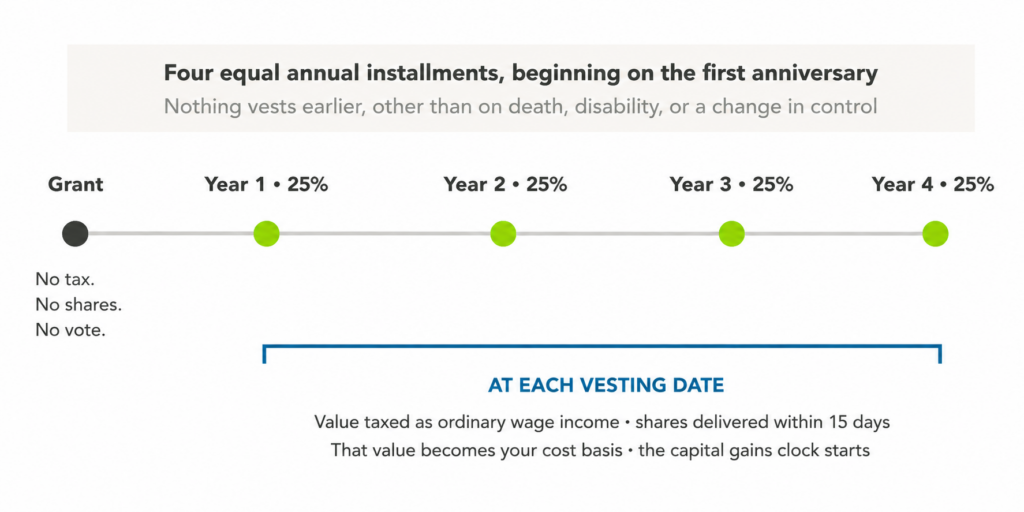
The vest is the tax event, not the sale. The value on the vesting date is compensation income whether or not a single share is sold. Shares that vest on a qualifying retirement or disability are delivered within thirty days; on death, within sixty.
Tax at vest, and the gap that appears the following April
When units vest, the fair market value of the delivered shares is ordinary compensation income. It is reported on the W-2 and is subject to federal income tax, Social Security up to the annual wage base, Medicare, and Massachusetts income tax for residents.
The agreement gives Boston Scientific two ways to collect the withholding. It may hold back whole shares with a value sufficient to cover the tax, or it may direct the plan broker to sell enough shares and remit the proceeds. It may also withhold from salary or require a cash payment. The choice is the company’s, not the participant’s.
The complication is the rate. Equity income is supplemental wages, and the default federal supplemental withholding rate is 22% on aggregate supplemental wages up to $1 million in a calendar year, rising to 37% above that threshold. An employee whose actual marginal federal rate is 32% or 35% is under-withheld on every vest by the difference, and the shortfall is invisible until the return is filed.
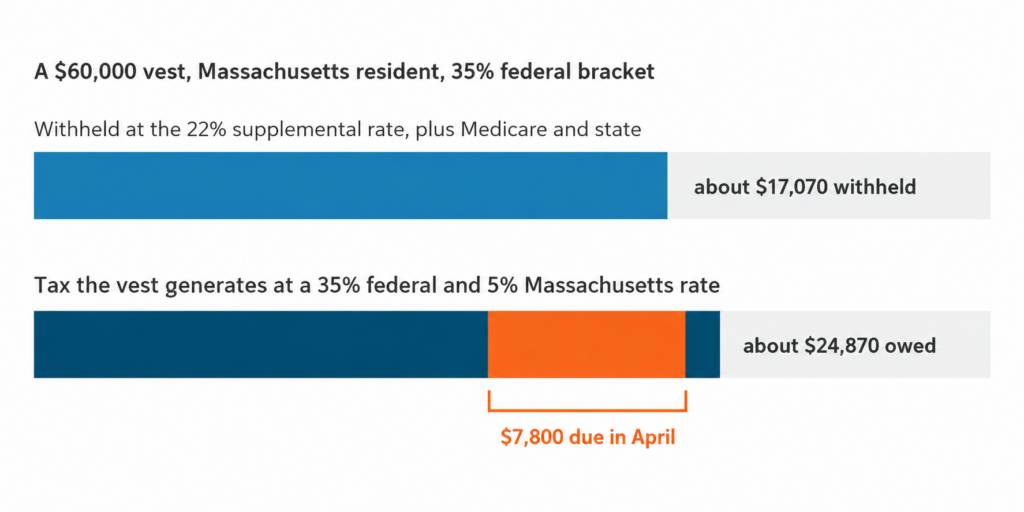
Illustration only. Assumes a 35% federal marginal rate, Massachusetts at 5%, and Medicare at 1.45%, with Social Security already satisfied for the year. Massachusetts also applies a 4% surtax to income above an annually indexed threshold.
The correction is procedural rather than clever. Identify the vesting dates in advance, project the income they will add, and adjust either Form W-4 withholding or quarterly estimated payments before the fourth quarter closes. Employees with several grants vesting in the same month, or with a vest landing in the same year as a bonus and an ESPP disposition, are the ones most often surprised.
Stock options under this plan
Options granted under the plan are non-qualified unless the committee expressly designates otherwise, so the incentive stock option rules, including the alternative minimum tax exposure that comes with them, generally do not apply here. Every option must carry an exercise price no lower than the closing price on the grant date, and the term cannot exceed ten years.
Recent option grants have followed the same schedule as the unit awards: four equal annual installments beginning on the first anniversary. Exercising is a taxable event. The spread between the exercise price and the market price on the exercise date is ordinary compensation income, reported on the W-2 and subject to withholding. Any movement after that date is a capital gain or loss measured from the exercise-date value.
An option carries no value at all if the market price sits below the exercise price, and the plan closes the obvious escape hatch. Section 1 prohibits repricing an outstanding award, exchanging it for a lower-priced award, or canceling it for cash or a replacement grant, without stockholder approval. Underwater grants stay where they are unless stockholders vote otherwise.
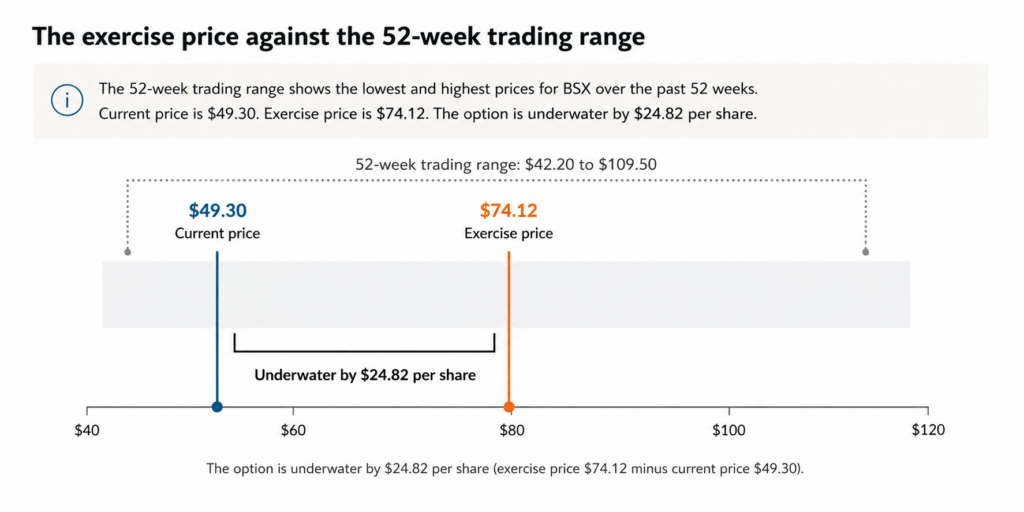
Price data as of the August 6, 2026 close. Exercise price from the company’s February 12, 2026 grant-date filings. An underwater option is not a loss and it is not gone: the grant keeps its full ten-year term, running into 2036. Nothing here is a forecast.
The one-year rule: the single most consequential provision
Both the restricted stock unit agreement and the non-qualified stock option agreement contain the same condition, and it is the provision most likely to cost real money.
If employment ends by reason of Retirement and the employee has remained in continuous service through the first anniversary of the grant date, all unvested units and all unexercised option shares from that grant vest immediately. For options, the grant then remains exercisable for the remainder of its original term. That is an unusually generous provision; many plans give retirees ninety days.
If Retirement occurs before the first anniversary of the grant date, that grant is forfeited in its entirety.
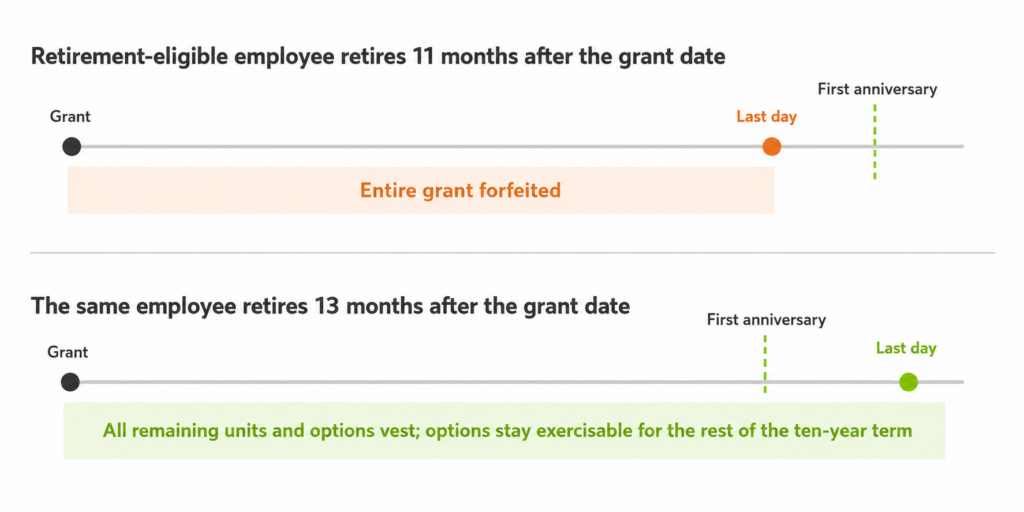
The test applies grant by grant. An employee with four outstanding annual grants may satisfy the condition on three of them and fail it on the newest one.
Retirement, as the plan defines itFor awards granted on or after January 1, 2012, Retirement means employment ends when all three of the following are true: the participant has reached age 55, has accrued at least five years of service, and the sum of age and years of service equals or exceeds 65.
For awards granted on or before December 31, 2011, the thresholds are age 50, five years of service, and a combined total of 62.
An employee who is 56 with eight years of service has a combined total of 64 and does not qualify. Twelve additional months of service satisfy both the service clock and the sum. The definition is arithmetic, and the arithmetic can be planned.
What happens to each award when employment ends
The plan and the current award agreements treat departures differently depending on the reason. One detail applies to all of them: the termination date is the last day of active service. It is not extended by a notice period, by garden leave, or by a severance continuation period, and the agreement says so explicitly.
| Reason employment ends | Unvested Restricted Stock Units | Stock options |
|---|---|---|
| Retirement, on or after the first anniversary of the grant | Vest immediately; shares delivered within 30 days | Vest immediately; exercisable for the remainder of the original term |
| Retirement, before the first anniversary of the grant | Forfeited in full | Forfeited in full |
| Death | Vest immediately; delivered within 60 days | Vest immediately, subject to the terms of the grant |
| Disability | Vest immediately; delivered within 30 days | Vest immediately, subject to the terms of the grant |
| Resignation, layoff, or any other termination | Forfeited on the termination date | Unvested forfeited; vested exercisable for the shorter of one year or the remaining term |
| Termination for Cause | Forfeited on notice | All options forfeited, vested and unvested |
| Change in control | Assumed or substituted by the acquirer; if neither, vesting accelerates | Same treatment as unit awards |
Two further provisions deserve attention. Awards are not transferable, and the plan states that this includes transfers in connection with a divorce or other domestic separation. Unvested Boston Scientific equity cannot simply be reassigned to a former spouse in a property settlement the way a retirement account can be divided by a domestic relations order, which pushes the negotiation toward offsetting assets or a deferred distribution arrangement. Anyone dividing marital property that includes unvested equity should have the award agreements read before the agreement is drafted, not after. Our life transitions work covers that intersection.
Separately, all awards are subject to the company’s recoupment policy and to the clawback rules adopted under the Dodd-Frank Act, which apply to current and former executive officers in defined circumstances.
Everything above concerns equity. A departure also raises the 401(k) rollover decision, Net Unrealized Appreciation on the Company Stock Fund, healthcare bridging, and the timing of any Deferred Bonus Plan distribution, all covered in our Boston Scientific employee benefits guide.
Selling ESPP shares: qualifying and disqualifying dispositions
The stock purchase plan’s pricing mechanics, including how the lookback sets the purchase price, are covered in the Boston Scientific employee benefits guide. That article does not cover what happens when the shares are sold, and that is where the tax outcome is decided.
Shares bought through a Section 423 plan carry two holding periods that run at the same time. A sale is a qualifying disposition if it occurs more than two years after the first day of the offering period and more than one year after the purchase date. Anything earlier is a disqualifying disposition.
| Qualifying disposition | Disqualifying disposition | |
|---|---|---|
| When | More than 2 years from the offering start date and more than 1 year from the purchase date | Any earlier sale, including a same-day sale at purchase |
| Ordinary income | The lesser of 15% of the price on the offering start date, or the total gain on the sale | The full discount measured on the purchase date, regardless of what the shares later sell for |
| Everything above that | Long-term capital gain | Capital gain or loss from the purchase-date value |
| If sold at a loss | None of the discount is treated as ordinary income | Ordinary income can exceed the actual profit, and the offsetting capital loss is limited each year |
The asymmetry is the point. A same-day sale converts the discount into ordinary income and closes the position, which is a defensible choice for anyone managing concentration. Holding for the qualifying period can convert part of the benefit to long-term rates, but it also means holding concentrated stock for two years to do so. Both are reasonable. Neither should happen by accident.
Two restrictions apply after purchase and catch people out. Shares generally may not be transferred until three months after the last day of the offering period in which they were acquired. And shares acquired in a Section 423 offering and held with the designated broker generally may not be moved to another brokerage account for two years following the first day of the related offering period. No tax is withheld at purchase; the tax arrives when the shares are sold, usually without a corresponding withholding entry on the W-2.
Measuring total exposure
Concentration is not a problem in itself. A 40% decline in a holding that represents 8% of investable assets is an event to note. The same decline in a holding that represents half of investable assets is a different kind of event, and it tends to arrive in the same season as other pressures on the same employer.
What matters is that the total has been measured, that the tax cost of reducing it has been quantified, that any trading window or preclearance obligation is known, and that the size of the position is the result of a decision rather than of accumulation by default. Boston Scientific’s own award agreement makes the point in its own language: no company employee is permitted to advise participants on whether to acquire or sell shares under the plan, and participants are advised to consult their own advisors.
The calculator below assembles the pieces.
Boston Scientific equity snapshot
Enter what you hold. Everything updates as you type, and nothing is sent anywhere.
Vesting units
—
—
—
—
Stock purchase plan, per six-month period
—
—
—
—
Stock options
—
—
—
Total company stock exposure
—
—
—
—
—
—
Stock Fund
Vesting units
Options
Everything else
About this tool. An interactive educational tool. It performs arithmetic on the figures you enter and does not retrieve your account, plan, or grant information. All calculations run in your browser. The figures you type are not transmitted to, collected by, or stored by Finivi Inc.
Assumptions and limitations. Results are estimates and are hypothetical in nature. The tool applies one flat federal marginal rate and one flat state rate to the amounts entered. It does not account for the Social Security wage base, the additional Medicare tax, the Massachusetts surtax, alternative minimum tax, the net investment income tax, filing status, deductions, other income, gains or losses on shares already held, taxes in states other than Massachusetts, or any trading window, blackout period, or preclearance obligation. Stock purchase plan figures assume contributions continue for a full six-month offering period. Option figures show intrinsic value at the share price entered, not fair value, and assume the shares are vested and exercisable. No result is a projection or forecast of future investment performance, of the price of any security, or of any tax outcome, and actual results will differ. A description of the criteria and methodology used, including all assumptions and limitations, is available on request at info@finivi.com.
Not advice. Educational only, and not personalized investment, tax, accounting, or legal advice. It is not a recommendation to buy, sell, or hold any security, to participate in or withdraw from any plan, or to exercise, hold, or sell any equity award. Finivi Inc. is not a law firm or an accounting firm. Confirm every plan provision against your Summary Plan Description, your Equity Award and Acceptance Summary, and your grant agreements, which govern.
Six items worth checking this quarter
- Every outstanding grant, listed with its grant date. The one-year condition is tested grant by grant, and the newest grant is the one at risk in any near-term departure.
- Your retirement-eligibility arithmetic. Age, years of service, and the sum. If the sum is close to 65, the value of a few additional months may be larger than a year of salary.
- Withholding against your actual bracket. Total the vests scheduled for this calendar year and compare the tax they generate to the 22% that will be withheld.
- Whether your ESPP shares are still inside the transfer restrictions. Three months from the end of the offering period, and two years with the designated broker, before they can move.
- The aggregate position. Vested shares, Company Stock Fund, unvested units, and in-the-money options, as a percentage of investable assets.
- Any separation date under consideration in the next twenty-four months. Mapped against grant anniversaries, the June 30 and December 31 purchase dates, and the one-year option exercise window that opens on a non-retirement departure.
Ready for a second set of eyes?
We advise Boston Scientific employees regularly, and we are happy to read your grant agreements against a separation date and flag anything worth adjusting. There is no cost and no obligation.
A review typically covers:
- Every outstanding grant, tested against the one-year retirement condition
- The tax on your next twelve months of vesting, and whether withholding covers it
- Option grants, their exercise windows, and the ten-year expiration dates
- Total company stock exposure as a share of investable assets
Sources
Plan provisions described here are drawn from the Boston Scientific Corporation Amended and Restated 2011 Long-Term Incentive Plan, as amended January 1, 2025, filed as an exhibit to the company’s Annual Report on Form 10-K; the Global Restricted Stock Unit Award Agreement and the Global Non-Qualified Stock Option Agreement filed as exhibits under that plan; the Boston Scientific Corporation Employee Stock Purchase Plan, amended and restated effective July 1, 2026, as filed with the Securities and Exchange Commission and included as an annex to the 2026 definitive proxy statement; the Relative Total Shareholder Return and Organic Net Sales Growth performance share programs for the 2025 through 2027 performance period; and Forms 4 filed by company officers reporting the February 12, 2026 annual grants. Share price references are as of the August 6, 2026 close. Federal supplemental withholding rates are set by IRS regulation, and the Section 423 holding-period rules are found in Internal Revenue Code Section 423 and the regulations thereunder. Current plan provisions should be confirmed against your Summary Plan Description, your Equity Award and Acceptance Summary, and the grant documents available through the plan’s stock plan service provider, which are the controlling employee-facing documents.
Finivi Inc. is not affiliated with, endorsed by, or sponsored by Boston Scientific Corporation or any affiliated entity. This employer is named here only to identify groups of employees the firm serves. References to benefit provisions come from publicly available employer and plan materials, including documents filed with the Securities and Exchange Commission, and are included for identification and educational purposes. This material is educational and is not personalized investment, tax, accounting, or legal advice, and it is not a recommendation to buy or sell any security or to adopt any particular strategy. Everyone’s situation is different. Benefits vary by employing entity, hire date, and location, and are subject to change. Plans described here have been amended over time and may be amended again. If anything here conflicts with a plan document or grant agreement, those documents govern. Investing involves risk, including the possible loss of principal. Advisory services offered through Finivi Inc., an SEC Registered Investment Advisor. Registration does not imply any particular level of skill or training.
