
What this guide covers
A practical walk-through of the parts of Boston Scientific’s compensation package that most affect long-term wealth:
- The 401(k) match and its unusual two-tier structure
- Why the automatic enrollment default leaves money on the table
- The Employee Stock Purchase Plan, restated effective July 1, 2026
- The channels through which company stock accumulates, and why the total is what matters
- Why some grants say Restricted Stock Unit and others say Deferred Stock Unit
- In-kind distributions and Net Unrealized Appreciation planning
- The HSA as a long-term investment vehicle
- The Deferred Bonus Plan for eligible management
- The planning window before any departure or retirement
Boston Scientific’s compensation package rewards employees who read it carefully. The 401(k) match is structured to pay disproportionately at one specific contribution rate. The Employee Stock Purchase Plan was amended and restated effective July 1, 2026, so guidance published before this summer is no longer current. Company stock accumulates through several parallel channels, each with its own tax profile and its own governing document.
At Finivi, we advise Boston Scientific employees across a wide range of roles and career stages. The clients who extract the most value from these programs are those who understand how the pieces interact, not simply what each does. What follows is drawn directly from Boston Scientific’s most recent Form 11-K, the amended ESPP as filed with the SEC, the 2026 proxy statement, and the current equity award agreements.
January 1 and July 1. ESPP offering periods begin, with enrollment in the preceding month. Once a period starts, the contribution percentage cannot be increased.June 30. Deferred Bonus Plan election deadline for the bonus year, for eligible management employees.July 1, 2026. The amended and restated ESPP took effect. Guidance published before this summer describes the earlier version.
This guide covers the benefits package. For equity awards in depth, including RSU and option mechanics, the tax at vest, the one-year retirement rule, and ESPP disposition rules, see Boston Scientific Stock Compensation: How RSUs, Stock Options, and the ESPP Work.
The 401(k) match is structured to reward one specific contribution rate
Boston Scientific’s 401(k) Retirement Savings Plan is a safe harbor plan under IRC Section 401(k)(12)(B). The employer match has two tiers: 200% on the first 2% of eligible compensation, and 50% on deferrals above that, up to a maximum company contribution of 6% of pay.
The first tier is where the plan is unusual. On a $200,000 salary, deferring 2% contributes $4,000 of your own money and produces $8,000 from Boston Scientific. There is not much else in personal finance that pays a two-to-one return on the first dollar, and for anyone still deciding between retirement contributions and other financial priorities, the first two percent of salary should be treated as an obvious yes.
The second tier is more conventional. Increasing your deferral from 2% to 6% adds $8,000 of your own contributions and $4,000 of employer contributions on that same $200,000 salary. Still worthwhile, but the marginal match rate drops sharply, which changes how the incremental dollar competes against a mortgage payoff, a taxable brokerage account, or an HSA.
Two structural details reinforce the value of the plan. First, participants are fully vested immediately in both their own contributions and the company match. There is no cliff and no graded schedule, which is uncommon among plans of this scale and materially affects the calculus of any career move. Second, the plan permits deferrals of 1% to 50% of eligible compensation, subject to annual IRS limits. Most participants operate well below that ceiling.
What the match pays at each deferral rate

Illustrated on a $200,000 salary, using the figures in the plan.
The first two percent is matched two for one. Everything above it
is matched fifty cents on the dollar, to a company maximum of 6% of pay.
Automatic enrollment was not designed to be optimal
The plan enrolls eligible employees automatically at 2% of compensation and escalates that rate by 1% per year, reaching 6% in the fifth plan year. Participants may opt out or modify the rate at any time.
Applied against the match schedule, the ramp produces the following company contributions:
- 2% deferral: 4% employer contribution
- 3% deferral: 4.5%
- 4% deferral: 5%
- 5% deferral: 5.5%
- 6% deferral: 6%
Over those five years, the difference between the automatic escalation path and deferring 6% from day one comes to roughly 5% of one year’s compensation in foregone employer contributions. On a $200,000 salary, that is approximately $10,000 in principal alone, before any investment growth.
Automatic enrollment exists because it substantially raises participation, and by that measure it functions as intended. It was not designed to optimize outcomes for any individual employee. Employees who accepted the default and never revisited it are the highest-value audience for this material.
The automatic escalation path, and what each step earns
| Plan year | Your deferral | Company contribution | Still on the table |
|---|---|---|---|
| Year 1 | 2% | 4.0% | 2.0% |
| Year 2 | 3% | 4.5% | 1.5% |
| Year 3 | 4% | 5.0% | 1.0% |
| Year 4 | 5% | 5.5% | 0.5% |
| Year 5 | 6% | 6.0% | None |
The employee stock purchase plan was restated effective July 1, 2026
Boston Scientific’s stockholders approved an amended and restated ESPP at the April 30, 2026 annual meeting. The restated plan took effect July 1, 2026. Material published before this summer describes an earlier version.
Longer-tenured employees may still refer to the program as GESOP. The plan was originally adopted in 2006 as the Global Employee Stock Ownership Plan and was subsequently renamed the Employee Stock Purchase Plan, which is why both names still appear in circulation.
The mechanics are straightforward but consequential. For a Section 423 offering, the purchase price is 85% of the lesser of the fair market value on the offering commencement date or on the purchase date. Offering periods run six months and begin January 1 and July 1, with enrollment in the preceding month. Contributions range from 1% to 10% of compensation in whole percentages. Once an offering period begins, participants cannot increase their percentage, though they can suspend contributions and withdraw them.
The lookback provision, not the 15% discount itself, is the source of most of the plan’s value. When the stock rises during an offering period, the purchase price is anchored to the lower opening value, and the effective discount exceeds 15%. When it falls, participants buy at 85% of the lower closing value, still ahead of anyone purchasing on the open market that day.
For employees hesitant to add further concentration in Boston Scientific stock, the plan permits a defensible middle path: participate at a meaningful percentage, capture the discount, and sell the shares shortly after they settle. Holding is not required to benefit from the discount.
Whether that sale is a qualifying or a disqualifying disposition changes the tax materially, and a falling share price can make the ordinary income exceed the actual profit. Those rules, along with the transfer restrictions that apply after purchase and the annual and per-period limits, are set out in Boston Scientific Stock Compensation.
How the lookback sets your purchase price
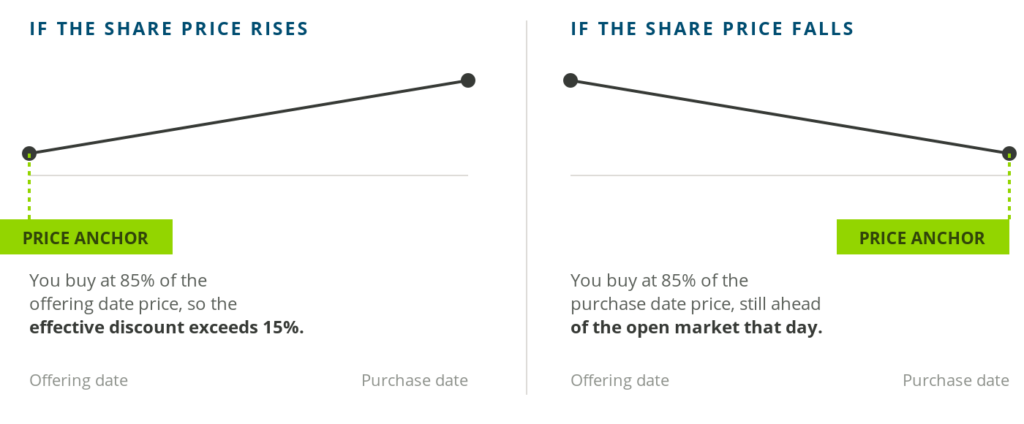
Offering periods run six months, beginning January 1 and July 1. The purchase price is 85% of the lesser of the fair market value on the offering commencement date or on the purchase date.
Company stock accumulates through more channels than most employees track
Boston Scientific stock reaches an employee’s balance sheet through several parallel paths, and while each is easy to track individually, the aggregate exposure is what matters:
- The Company Stock Fund inside the 401(k)
- ESPP shares acquired at each semi-annual purchase date
- Restricted Stock Units and Performance Share Units vesting under the 2011 Long-Term Incentive Plan
- Vested shares held in a brokerage account from grants settled in prior years
- The undocumented exposure: salary, bonus, health coverage, and career trajectory all resting on the same employer
Concentrated positions are not inherently a problem. A 40% decline in a position representing 8% of net worth is a manageable event. The same decline in a position representing 50% of investable assets is a materially different one, and it is often experienced at exactly the moment other financial pressures compound.
There is no universally correct exposure percentage. What matters is that the total has been measured, that the tax cost of reducing it has been quantified, that any trading window or preclearance obligations are known, and that the size of the position reflects an active decision rather than accumulation by default. Boston Scientific Stock Compensation includes a calculator that produces the percentage across all four channels.
One recent change is worth noting. Since August 1, 2024, participants may allocate no more than 50% of future 401(k) contributions to the Company Stock Fund. This constrains new inflows but does not address existing balances and does not apply to ESPP or equity award accumulation. CapTrust serves as independent fiduciary for the Company Stock Fund within the plan, but no institution monitors aggregate exposure across the employee’s full balance sheet. That responsibility sits with the participant.
Five channels, one exposure
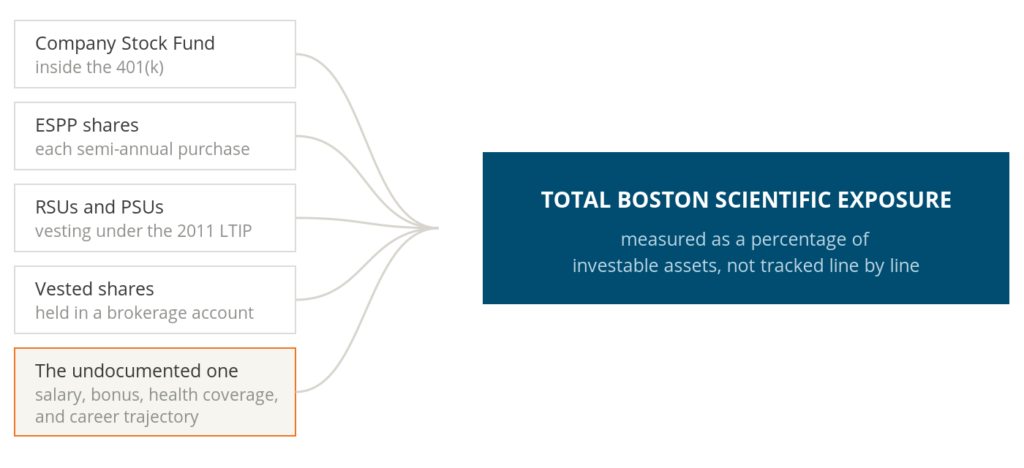
Each channel is easy to track on its own. The aggregate is what determines whether a decline is a manageable event or a material one. Since August 1, 2024, no more than 50% of future 401(k) contributions may be directed to the Company Stock Fund.
RSU and DSU terminology reflects different grant vintages
Employees with longer tenure at Boston Scientific may hold equity awards under two different labels. Grants issued in earlier years were structured as Deferred Stock Units. Current grants, including the 2024 Global Restricted Stock Unit Award Agreement, are structured as Restricted Stock Units. Both were issued under the 2011 Long-Term Incentive Plan, subsequently amended and restated. The economic substance is largely consistent across both forms, but the terminology has evolved.
The practical implication is administrative. When reviewing equity award documentation, employees searching for a single term may overlook grants filed under the other. Aggregating the full grant history requires searching for both labels.
The governing terms of any grant are contained in the specific award agreement attached to that grant, not in any general summary. The award agreements have been amended repeatedly over the life of the plan, and material provisions, including treatment on retirement eligibility, vesting acceleration on qualifying terminations, and withholding mechanics at vest, may differ meaningfully between a grant made three years ago and one made this year. Each agreement should be reviewed on its own terms.
Vesting itself is a taxable event, and the withholding applied at vest frequently falls short of the participant’s actual marginal rate. The full lifecycle of a unit award, the size of that withholding gap, stock option terms, and the one-year condition that decides whether unvested equity accelerates at retirement or is forfeited are covered in Boston Scientific Stock Compensation.
The HSA is a retirement account wearing healthcare clothing
Boston Scientific offers a high-deductible health plan paired with a Health Savings Account, alongside its other medical options. For employees who can absorb the deductible without touching the account, the HSA is arguably the most tax-advantaged vehicle available in the U.S. tax code: contributions are pre-tax, growth is untaxed, and qualified withdrawals are untaxed. No other account offers all three.
For 2026, the IRS contribution limits are $4,400 for self-only HDHP coverage and $8,750 for family coverage, with an additional $1,000 catch-up contribution permitted at age 55 and older. Any employer contribution counts toward that limit. Employees over the catch-up threshold with family coverage can move $9,750 into the account in a single year, more than a Roth IRA permits.
The common mistake is treating the HSA as a checking account for current medical expenses. Doing so captures the deduction on the way in, but forfeits decades of tax-free growth. The higher-value approach, for anyone with the cash flow to sustain it, is to pay routine medical expenses out of pocket, retain the receipts, and let the HSA balance compound. Qualifying expenses paid in earlier years can be reimbursed from the HSA at any point in the future, tax-free, with no statute of limitations. The account effectively becomes a shadow Roth with a receipt-backed emergency valve.
Once in retirement, HSA funds cover Medicare Part B, Part D, and Medicare Advantage premiums, along with long-term care premiums up to age-adjusted limits and most qualified medical expenses. After age 65, non-medical withdrawals are permitted at ordinary income rates, which makes the account behave like a traditional IRA in a worst case and better than a Roth in the base case.
The HDHP is not the right choice for every household. Employees with predictable, ongoing medical expenses may come out ahead in a traditional PPO. But for employees choosing the plan primarily for the HSA, the account should be invested for long-term growth, not left in the default cash sweep, and the medical bills should be paid from other sources whenever the budget permits.
2026 HSA contribution limits
| Coverage | 2026 limit | With age 55 catch-up |
|---|---|---|
| Self-only HDHP | $4,400 | $5,400 |
| Family HDHP | $8,750 | $9,750 |
Planning for departure: retirement, a new role, or anything in between
The period immediately before leaving Boston Scientific is when the most avoidable financial mistakes tend to occur. The window between filing notice and the last day of employment is short, the paperwork is layered, and several benefits either accelerate, terminate, or shift character depending on the timing and reason for departure. A structured review before that window closes is worth substantially more than one afterward.
Equity awards deserve the first look, and they carry the sharpest deadline in the package. Retirement-eligible participants often qualify for acceleration under provisions that ordinary resignations do not trigger, and meeting the eligibility definition by a matter of weeks can materially change the value of unvested equity. The specific rules, including the one-year condition that can forfeit an entire grant, are set out in Boston Scientific Stock Compensation.
The ESPP requires attention on a parallel track. Any contributions in the current offering period will be returned or applied to a final purchase depending on the plan’s rules and the timing of separation. Employees planning a departure between purchase dates should understand which outcome applies to them before setting the exit date.
The 401(k) balance presents four options: leave the assets in the plan, roll them into an IRA, roll them into a new employer’s plan, or take a distribution. The default answer is not always the best answer. Boston Scientific’s plan carries institutional pricing and includes the Company Stock Fund, which is the only vehicle from which Net Unrealized Appreciation treatment can be executed. A rollover to an IRA eliminates that option permanently. Any employee separating with meaningful appreciated employer stock in the plan should evaluate NUA before initiating a rollover, not after.
Healthcare coverage also requires bridging. Boston Scientific coverage generally terminates at the end of the month of separation. COBRA is available but expensive. Marketplace coverage may qualify for premium tax credits depending on the following year’s income projection. For retirees between 55 and 65, healthcare is often the single largest budget line, and it should be modeled before separation, not discovered afterward.
Deferred compensation and Deferred Bonus Plan balances become payable on separation, subject to the distribution election on file. A lump-sum election combined with severance, final RSU vesting, and unused paid time off can concentrate an unusual amount of income into a single tax year. The distribution election on the Deferred Bonus Plan should be reviewed well before any expected departure, since changes to the election are subject to Section 409A restrictions and cannot generally be made in the twelve months preceding separation.
For employees approaching a planned retirement, the two or three years before the exit date are typically the most productive planning window in a career. Roth conversion capacity opens up as W-2 income drops, tax brackets can be managed intentionally, concentrated stock positions can be unwound at a controlled pace, and required minimum distribution exposure can be mitigated in advance. None of this happens by default. All of it benefits from being modeled early.
In-kind distributions and net unrealized appreciation
The 401(k) plan permits benefit distributions in the form of installments, partial payments, or a lump sum. Distributions from the Company Stock Fund may be taken in kind at the participant’s request.
The in-kind provision is what enables Net Unrealized Appreciation planning. Under the right circumstances, distributing appreciated employer stock in kind, rather than rolling it into an IRA, allows the appreciation above the original cost basis to be taxed at long-term capital gains rates when the shares are later sold, rather than at ordinary income rates on the full distribution.
The eligibility conditions are unforgiving. NUA treatment requires a qualifying triggering event, typically separation from service, disability, death, or reaching age 59½, followed by a lump-sum distribution of the entire account balance within a single taxable year. Rollovers, partial distributions, or timing errors can disqualify the treatment entirely, at which point the tax liability arrives without the benefit. NUA is worth modeling well in advance of any potential trigger, and it is not a decision to make in isolation from the participant’s broader tax picture.
Deferred Bonus Plan: the election deadline is June 30
Eligible management employees may participate in the Deferred Bonus Plan, which permits deferral of up to 75% of the annual award under the Annual Bonus Plan. The election must be made by June 30 of the bonus year. Deferred amounts are paid at the earlier of separation from service or an elected distribution date, either as a lump sum or in annual installments over two to five years, as elected by the participant. Investment options generally mirror the 401(k) lineup with one exception: deferrals cannot be invested in the BSC Stock Fund.
The deferral election typically receives more attention than the distribution election, though the distribution election often has larger tax consequences. Compensation deferred at a 37% marginal rate and later distributed as a lump sum, layered on top of Social Security, required minimum distributions, and vesting equity in the same year, may fall into a bracket comparable to or higher than the one it was deferred from. The installment option exists to smooth exactly this stacking effect.
Deferred amounts are also unsecured obligations of the company. In an insolvency scenario, participants stand as general creditors. The probability of that outcome at Boston Scientific’s scale is low, but it is not zero, and it is one of the reasons to bound the deferral percentage rather than maximize it.
Seven items worth reviewing this quarter
Roughly in descending order of financial impact:
- Current 401(k) deferral percentage, and whether it still reflects the automatic enrollment default rather than an active election.
- Total Boston Scientific stock exposure across the Company Stock Fund, ESPP holdings, vested shares in a brokerage account, and unvested RSU or DSU grants, expressed as a percentage of investable assets. Boston Scientific Stock Compensation has a calculator for this.
- ESPP enrollment status and contribution percentage, along with a documented policy for holding or selling shares at purchase.
- Equity award agreements, reviewed grant by grant, for vesting terms, retirement eligibility provisions, and treatment on qualifying terminations. The one-year condition inside those provisions is explained in Boston Scientific Stock Compensation.
- HSA contribution rate and investment allocation, with specific attention to whether the balance is being invested for growth or left in a cash sweep.
- Deferred Bonus Plan participation, if eligible, with specific attention to whether the distribution election aligns with the expected retirement income profile.
- Any planned departure, retirement, or role change in the next twenty-four months, mapped against equity vesting, ESPP purchase dates, healthcare bridging needs, and Deferred Bonus Plan distribution timing.
Most of these can be addressed by an informed employee in an afternoon. None of them require an advisor to complete, though the interaction effects across the full compensation package are where coordinated planning tends to produce the most value.
Ready for a second set of eyes?
We advise Boston Scientific employees regularly, and we are happy to review your current elections and flag anything worth adjusting. There is no cost and no obligation.
A review typically covers:
- Your 401(k) deferral rate against the two-tier match
- ESPP enrollment, and a policy for holding or selling at purchase
- RSU and DSU vesting schedules, grant by grant
- Total company stock exposure as a share of investable assets
Sources
Figures and plan provisions referenced here are based on Boston Scientific’s SEC filings, publicly available plan documents, and IRS publications as of the date of publication, as we understand them. Plans change; confirm current details with your human resources department or plan administrator before acting.
This article draws on the Boston Scientific Corporation 401(k) Retirement Savings Plan Form 11-K for the fiscal year ended December 31, 2025 (filed June 24, 2026) and its audited financial statements; the Boston Scientific Corporation Employee Stock Purchase Plan, Amended and Restated effective July 1, 2026, as filed with the Securities and Exchange Commission (Exhibit 10.1 to Form 8-K filed May 5, 2026); Boston Scientific’s 2026 Definitive Proxy Statement (DEF 14A); the Form 8-K reporting results of the April 30, 2026 annual meeting; the Form S-8 filed May 8, 2026 registering additional ESPP shares; and Boston Scientific’s Form of 2024 Global Restricted Stock Unit Award Agreement under the Amended and Restated 2011 Long-Term Incentive Plan (Exhibit 10.2 to Form 10-Q filed May 1, 2024). Deferred Bonus Plan provisions are described in Boston Scientific’s proxy statements. HSA contribution limits are from IRS Revenue Procedure 2025-19. IRC Section 409A and Publication 969 govern deferred compensation distribution timing and HSA rules, respectively. Current-year plan provisions, including match, contribution, medical, and disability terms, should be confirmed against the Summary Plan Description and current Summary of Benefits and Coverage, which are the controlling employee-facing documents and are available through the plan administrator.
Our advisors are knowledgeable about Boston Scientific employee benefits, retirement plans, equity compensation, and related financial planning concepts. Company retirement, equity, and welfare plans are subject to change. For specific plan information, consult your human resources department or the plan administrator.
Finivi Inc. is not affiliated with, endorsed by, or sponsored by Boston Scientific Corporation or any affiliated entity. This employer is named here only to identify groups of employees the firm serves. References to benefit provisions come from publicly available employer and plan materials, including documents filed with the Securities and Exchange Commission, and are included for identification and educational purposes. This material is educational and is not personalized investment, tax, accounting, or legal advice, and it is not a recommendation to buy or sell any security or to adopt any particular strategy. Everyone’s situation is different. Benefits vary by employing entity, hire date, and location, and are subject to change. Plans described here have been amended over time and may be amended again. If anything here conflicts with a plan document or grant agreement, those documents govern.

You must be logged in to post a comment.